Categories
News

Back to the Future with #TeamDTW

We all know its Back to the Future Day today. In order to celebrate the success of Doc and Marty we thought we’d go back to the future ourselves.

So we asked DTW founder Pete Whelan (the original one) to cast his mind back to the dim and distant world of 1989 when DTW came kicking and screaming into life.

You want to know how comms has changed in the past 26 years – read on.

You want to know how it will change in the next 26 years – that’s a different blog post. Watch this space.

Chris Taylor – DTW Managing Director – October 21 2015


Back to the future with DTW

In 1989….

Tim Berners-Lee invented the World Wide Web…

Mark Zuckerberg celebrated his fifth birthday…

… and DTW was founded by a bunch of enthusiastic mates who had no idea of the revolution which was about to shake the foundations of the communications world in the next 25 years.

It must be difficult for a generation brought up with the worldwide web, super-fast digital communications and mobile technology to imagine how different life was in 1989, when DTW came kicking and screeching into life.

Screen Shot 2015-10-21 at 10.45.29

The first generation of slow, clunky personal computers was just becoming affordable to small businesses (we bought some, from a bloke called Alan Sugar – whatever happened to him?)

For our graphics studio, we took a punt at Apple Mac computers, the new kids on the block, as we began the transition from cut & paste and Letraset to slick digital design. I guess that’s been one certainty over the last 25 years, that Mac would continue to develop and deliver for designers.

Emails were non-existent. The important stuff came by post. The pace of life and work was a lot slower. Apart from the roads, of course – I used to drive down from Guisborough (edge of the North York Moors) to my central London clients via the sedate M1 in four hours, parking by their front doors.

In those days life for an agency was a whole lot simpler. There were just four basics for any client comms programme: PR; advertising (press or broadcast only); a new brochure (remember them) every year or two; and perhaps a “corporate video”.

Now that’s funny because video as a communications tool virtually disappeared for 20 years, then was sparked back into popularity by the emergence of YouTube and the emergence of a generation of people with an attention span of a few nanoseconds.  Déjà vu.

How did we imagine life in 2015? Well, the simple answer is we didn’t, any more than communicators now can guess what 2040 will be like. I guess we thought comms would be just like before but with more techie stuff to help…

Instead, social media in particular is changing the way the world works (and not always for the best), whilst the speed of digital is demanding instant response, bringing ever-greater pressures on communicators like us.

Did we think DTW would still be around a quarter century later? Possibly not. It’s a matter of pride to me that our agency is one of a handful which has survived and prospered through a world recession whilst adapting to the needs of the new communications landscape.

2040 here we come…

Pete Whelan (that’s the old one) – Founder and former Chief Exec

Screen Shot 2015-10-21 at 10.54.44

Categories
News

Presenting the facts

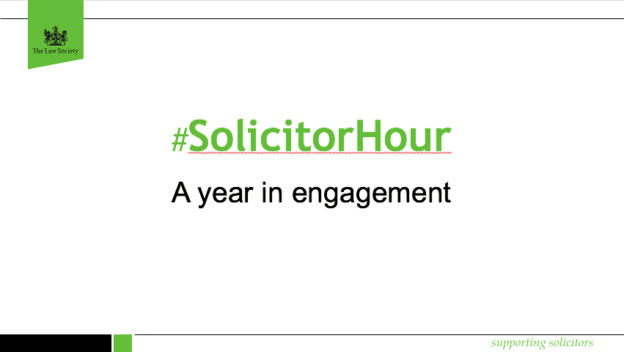
#Solicitorhour – a year in engagement from Guy Bailey

This week Emma Maule, social media officer from The Law Society and I were invited to give a presentation at a PARN communications event in London on Thursday.

PARN is the Professional Associations Research Network – the group that works with organisations that are made up of professional members such as the Law Society, the Royal Pharmaceutical Society and the Institute of Biomedical Science who hosted the event.

The topic was a review of #Solicitorhour – the twitter chat where members of the public interact with solicitors on a different topic weekly at 1pm on Thursdays, which has been operating for just over a year.

#Solicitorhour was the ideal topic to discuss as the event focused on how membership based organisations can better communicate with their members and the public on a regular basis.

We’re proud of the success we’ve been able to achieve in the previous 12 months.

  • 77 #Solicitorhour sessions
  • 13,016 tweets
  • 5 million timeline deliveries
  • 5 million users reached
  • 2,332 unique contributors

Other speakers included David Biggins from The Institution of Engineering and Technology on how to generate shareable content and from Sandra Scott from the UK Council for Psychotherapy on managing member content in magazines.

We had a great audience who asked several questions both about #Solicitorhour, the Use A Professional Use A Solicitor campaign we created for the Law Society in October 2014, and how an agency like ourselves can work successfully and seamlessly with a large, multi-faceted organisation like the Law Society.

The presentation is embedded above for you to view and download and I would be more than happy to answer any questions you have about the campaign or #Solicitorhour – apart from our future plans!

Categories
News

Facebook Reactions is coming…

Facebook has begun the roll out of its new ‘Reactions’ feature which is the much vaunted response to the age old clamour for a ‘dislike’ button. Users in Ireland and Spain (lucky them!) are the first to get access. Apparently these two markets have been picked as test beds for the functionality as they have fewer international connections than other markets Facebook operates in, as well as – in Spain’s case – allowing testing of how the emoji based reactions will go down with non English speaking users.

You can get an idea of how reactions will work from Facebook’s launch video:


So how will it work?

When ‘Reactions’ lands in the UK at some unspecified point in the not too distant future (exactly when will depend on the results of the aforementioned testing) the chances are it will be enabled for individual users’ accounts first, with Pages (the homes of businesses and brands) following on from that.

As well as having the ability to “Like” a post, users will also be able to react using five other emotions: “love,” “haha,” “yay,” “wow,” “sad” and “anger” – each coming with it’s own friendly emoji.


emojitop


Posts will include a tally of how many of each reaction has been applied to it and it’s worth noting that each user will only be able to apply one reaction to a post – so you won’t be able to ‘like’ and ‘yay’ the same post.

What will it mean for me?

Well, aside from your friends on Facebook being able to react to your posts in a load of different ways, the big news as I see it is how brands and businesses are going to handle this functionality being enabled on their Pages.

Online commentators are already pointing out how reactions has the potential to be misinterpreted and it’s still not clear what the implications will be in terms of the algorithms Facebook uses to push posts out into user’s news feed – it could be that a post with a greater number of ‘angry’ reactions gets given less weight by the algorithm than one with the same number of ‘wow’ reactions, but of course those reactions will be determined by the content of the post and the make-up of a Page’s audience.

There’s also the potential that the new system is open to abuse…

Evaluation

If, as expected, Facebook incorporates Reactions information into its analytics package, we’ll have access to a much more granular level of data through the analytics dashboard. This will help massively with things like promoted content targeting, as well as developing an understanding of a Page’s audience as a whole.

That said, it also opens up the engagement metric – something which is currently pretty hard and fast – to interpretation as to what a user’s sentiment was when they clicked on a particular reaction, so it will be important for Page owners to consider how they want to use and measure this data (as well as the weight and credence they give to it) in advance of it rolling out to their Page.

So, that’s our initial reaction to ‘Reactions’. There’ll be plenty more head-scratching as it takes hold in the UK in the near future. Before then the message for brands and companies is to prepare by understanding why your audience is engaging with you through Facebook in the first place. Then you’ll have a good idea of what they want from your content.

Categories
News

Infrastructure, infrastructure, infrastructure

Infrastructure, infrastructure, infrastructure. Hardly original I know (thanks Tony) but it seems that the government is upping both its rhetoric and hopefully its action around infrastructure investment this week with the creation of the new National Infrastructure Commission.

Categories
Insights

#FacebookDown

The Facebook website and mobile apps went offline for 40 minutes on Monday afternoon, the second short outage in a week and the third in three weeks, blaming, engineers tinkering, which was the reported cause for the previous outages.

Now what is a minor annoyance or disruption for the ordinary user, or benefit if it gives you the chance to have a cuppa and catch up on work, has real-world consequences for organisations.  Starting with Facebook themselves, their share price took a 4% hit (£56 a share) or 1% for every ten minutes. Then there are the cascading consequences for other apps and websites that use Facebook as their primary login method or are built on Facebook’s structure. Tinder, the popular dating app, is the highest profile example. There are also the hundreds of thousands of Facebook advertisers whose campaigns may have been postponed or lost as a result of the unscheduled stoppage – Facebook has to take their concerns seriously and make amends in short order.

Other social networks, primarily Twitter, had a lot of fun at their expense, providing an outlet for frustration and also underlining their own robust systems but the little blue bird and others are just as susceptible to a malfunctioning algorithm or even something as minimal as a 0 retyped as an O.  Computers are unlike people in that there is no shade of grey regarding their operating parameters. A program either runs or it doesn’t – there is no nearly right here.

Such rare events also illustrate the danger of building a business model or primary presence on a platform that is ultimately out of your control – both proprietary and technically.  If you have a website, it is very unlikely that the internet will go down as there are a myriad of redundancies and work round’s to avoid it. A single site or platform is much narrower and easier to disable no matter how popular or famous.

Facebook has a lot of engineers and data scientists who can solve and fix issues and game plan for likely future offline incidents. In honour of #FacebookDown, maybe you should game plan your own social survival strategy if your main showroom simply vanishes into thin air…