Categories
News

DTW helps secure Project of the Year award for Northern Spire

Teamwork and collaboration are always at the heart of excellent communications. That’s why it was great to be alongside some talented partners to win a major award for one of our biggest client projects this week.

Sunderland’s Northern Spire bridge was named Project of the Year: Engineering, Construction and Infrastructure 2018, at the Association for Project Management (APM) awards in London on Monday (26thNovember).

We collectively beat off some stiff competition to win the award that recognises great project management. Northern Spire was up against a number of outstanding engineering and infrastructure projects from across the UK, including the Royal Navy’s new HMS Queen Elizabeth aircraft carrier, medical research centre The Francis Crick Institute, Master Gas System Expansion Phase-1, by Saudi Aramco, and The Temperate House Project.

Karen and Chris from the DTW team have been working on site for the best part of three years, working alongside Atkins, Faithful+Gould, and AECOM, the Sunderland City Council team and main contractors Farrans and Victor Buyck, as well as numerous sub-contractors.

That has put communications and PR at the heart of the project and meant we have collectively been on the front foot when it comes to communication benefits and engaging with stakeholders.

Work began on Northern Spire in May 2015. During the three-year build programme, more than 2,000 people worked on the project, clocking up more than a million work-hours. It was built within its allocated £117m budget, two thirds of which was met by the Government and the remaining from Sunderland City Council.

During recent months, different aspects of the Northern Spire project have been recognised at award ceremonies up and down the country, from the design of the structure, to the methods used to construct it, project management and public engagement.

Collaboration is at the heart of what we do. Communications and PR has a part to play both internally and externally on big projects like this and we’re very fortunate that we get to work with some of the best in the business on this and other projects.

Categories
Insights

The lessons, fears and opportunities in AI

AI… it’s a Steven Spielberg film starring Jude Law right? It’s a distant concept that isn’t impacting us yet. Think again. Machine learning and AI is growing and already impacts everyone’s lives every day. As I learned in a compelling morning of presentations around AI in PR at the very impressive PROTO in Gateshead, hosted by the CIPR (Chartered Institute of Public Relations).

The thing is, AI (that’s artificial intelligence by the way) is already in our lives, from social media algorithms, to customer service chatbots on websites. I can guarantee we all encounter AI every day in some form or another.

AI is defined in the dictionary as:

A branch of computer science dealing with the simulation of intelligent behaviour in computers.
The capability of a machine to imitate intelligent human behaviour.

That’s quite a broad definition. If we took that at face value, a calculator is AI… so we need to add an extra layer to this, and that’s where machine learning comes in.

To quote AI startup Wordnerds: If it’s not making decisions, it’s not AI.

What struck me from the presentations I saw, is there are two aspects to perceptions of AI: Fear and opportunity.

Fear

Kerry Sheehan from the CIPR’s #AIinPR panel talked us through the impact that AI is having not only in our industry but across a lot of enterprise. On face value, AI is replacing a lot of work done by humans; doing it quicker and better, hence a fear that machines are taking our jobs; the robots are taking over!

Well, this is partly true. What machines are doing is taking away the entry-level work for graduates and young people to get into an industry. This is around the traditional skillsets such as risk management, data management, and listening; the day-to-day bits and bobs that get many of us starting out do to get the experience needed to take the next step on the career ladder. Without this work, what is the new starting off point for those coming into the industry at the beginning of their careers?

Opportunity

There are still some essential human skills that the robots will never be able to gain. Think strategy, creativity, ethics, and people management.

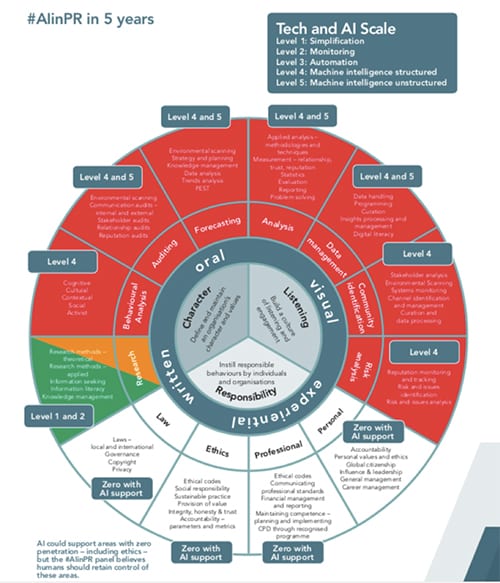
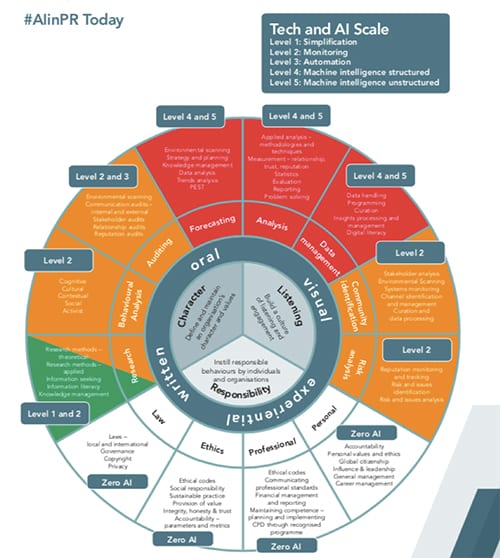
These two diagrams are the result of a study looking at the skillset in PR now and in 5 years, and how AI will impact on them.

Source: CIPR

As scary as new technology is, there is some real opportunity for all of us to use AI to improve our productivity and service, whatever line of business we operate in.

We at DTW have found opportunity in AI through some of the tools we use. We’ve been trialling a tool that automatically transcribes our videos so we don’t have to manually make subtitles (thus increasing accessibility of our clients’ messages). We use social media smart scheduling tools that analyse when the most engaging time of day is for our clients’ Twitter and Facebook accounts so we can post when they’ll get the most exposure.

So, these are some of the lessons we’re learning in PR around AI that can be applied to other industries:

  1. Don’t be scared. Take advantage of the technologies to improve your productivity and professional offering.
  2. Make sure you have an understanding of the technology. The CIPR is going to offer coding classes so PR professionals can create and better understand how AI programmes work.
  3. Don’t use tools for the sake of using them. Make sure they offer the right solution for you.
  4. We all have an ethical responsibility to ensure AI is influencing decisions in the right way (i.e. not biased or prejudiced or inappropriate). For example, Amazon became aware that children were learning how to talk through voice commands on their Echo devices, which meant they were learning a blunt way of talking: “Alexa, do this… do that”. So, they decided to adapt the AI technology to only respond to commands from children that included a ‘please’ or a ‘thank you’.

So, the robots? Not so scary after all!

Categories
News

DTW joins Northern Spire team to share tips on ensuring project success

The link between communications and PR and good project management is something we’re passionate about, so put us in a conference full of project managers and our ‘inner nerd’ starts to really show.

This week DTW joined the Northern Spire team at the Association of Project Managers’ Power of the Profession conference in Manchester.

Around 200 of the north’s leading project managers, from a diverse range of companies and sectors, including representatives from Shell, Northumbrian Water, the NHS and Transport for the North, gathered to share their best practice ideas on getting the most out of your people and processes in order to maximise production and success, and achieve greater outcomes for the community by managing projects more effectively and efficiently.

Key to the discussion was the importance of focusing on and communicating stakeholder and community benefits in project management, and the vital role stakeholder communication plays in ensuring the success of a project.

Members of the Northern Spire team from Farrans Construction, Faithful+Gould, Atkins and DTW exhibited, and presented to delegates on the importance of placing and communicating benefits at the heart of your project.

Here’s four DTW top tips for using communications to make your project a success:

  • Start with research and by listening to your stakeholders – communication is a two way street – make sure you listen to the concerns of your community – whether that is employees, customers, residents or retailers. Put yourself in their shoes, think about what their concerns are and make sure you address them.
  • Focus on benefits and tell your story – once you know where you are starting from because you’ve done your research and have clear objectives, take people on a journey and make sure your story focuses on the project benefits and outcomes at every stage.
  • Engage directly with people – be open, honest and transparent with your audience – even when you have bad news to tell them – and you’ll get the credit in the long run. It takes time, guts and sometimes broad shoulders, but remember that feedback is what you want – it will help you improve your project and deliver better outcomes.
  • Be a good neighbour – remember you are just passing through – projects are inevitably temporary, even if it doesn’t feel that way sometimes! You’re just dropping in as a temporary member of a real permanent community of residents, businesses or employees, and the project is for them, so putting their interests first is what it’s all about.

The communications budget on Northern Spire accounted for only 0.5% of the total project budget, yet the buy-in to community engagement, public and media relations from everyone, from Sunderland City Council, main contractor FVB Joint Venture, Atkins, Faithful+Gould, and sub-contractors on site, meant that communications ran through every fibre of the project.

Getting all of the project team on board took time and involved huge amounts of leg work at the beginning, however, the results far outweighed the budget and the effort, evidenced in the huge community pride demonstrated when the bridge was unveiled in August, and the 20,000 people who came to walk across the deck before it opened to traffic.

With communications, a little really does go a long way, and taking the time to involve people can make the difference between perceived success and failure.

Six months after a project is finished, very few people will remember whether it was delivered on time or on budget, but they will know whether or not they like it.

So, don’t leave that to chance. Take the community on the journey with you and then you will all arrive at the desired destination together.

Thanks for reading.

Karen